
The Official LoveDorset Corfe Castle Guide
Corfe Castle: A Thousand Years of History in the Heart of Purbeck
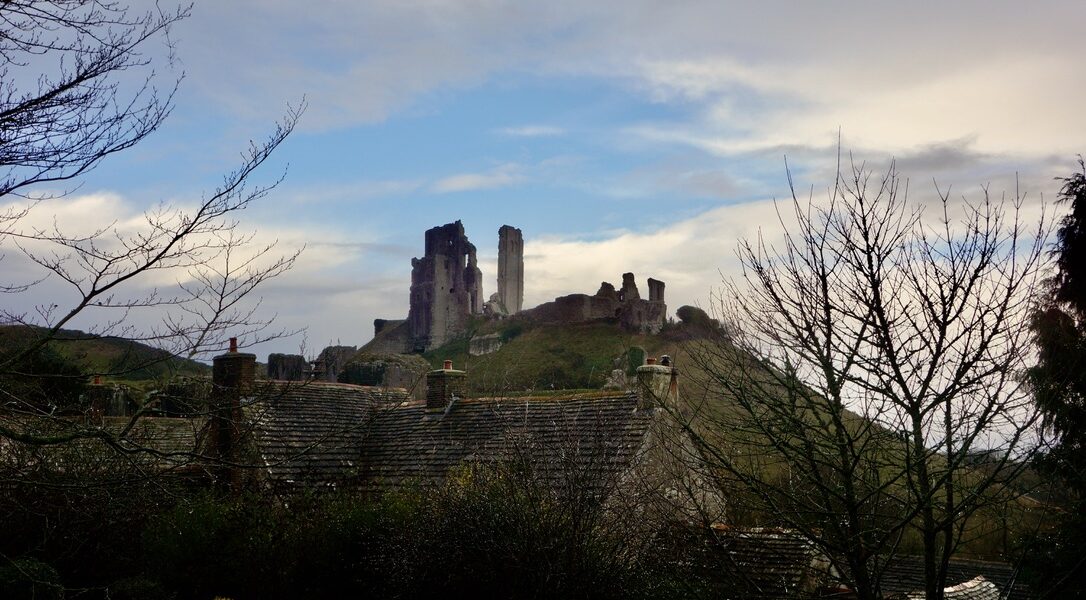
Rising from a natural hill in a gap of the Purbeck Hills, Corfe
Castle’s shattered towers and crumbling walls create one of the most
romantic ruins in all of England. This thousand-year-old fortress has
witnessed royal murder, Civil War siege, and deliberate destruction, yet
its broken silhouette remains one of the most evocative sights in
Dorset.
A Dark History
The first fortification on this strategic hilltop dates to the Saxon
period, and it was here in 978 AD that one of England’s most infamous
royal murders took place. The young King Edward, just 16 years old,
arrived at Corfe to visit his stepmother Ælfthryth and half-brother
Æthelred. While still mounted on his horse, Edward was stabbed by
members of the household. He managed to ride away but fell from his
horse and was dragged to his death. Æthelred became king—later known
as Æthelred the Unready—and Edward was eventually venerated as a saint
and martyr.
The stone castle visitors see today was begun by William the Conqueror
after 1066, making it one of the earliest Norman stone fortifications in
England. The keep, or great tower, was built partly on the curtain wall
of the inner bailey—an unusual arrangement that speaks to the
confidence of the Norman builders in their military architecture.
The Siege and Slighting
Corfe Castle’s most dramatic chapter came during the English Civil War.
In 1643, Parliamentary forces laid siege to the castle, which was held
for King Charles I by Lady Mary Bankes while her husband Sir John was
away with the Royalist army. With a garrison of just five men initially,
Lady Bankes organized the castle’s defence, recruited additional men,
and successfully held out against a force of over 500 Parliamentarians.
The first siege lasted six weeks before Royalist reinforcements arrived
to relieve the castle. But by 1645, Corfe was one of the last Royalist
strongholds in southern England. After a second siege, the castle
finally fell—betrayed from within by one of its own officers who
allowed Parliamentary forces entry through the gates.
Parliament ordered the castle ‘slighted’—deliberately destroyed to
prevent its future military use. Gunpowder was used to bring down the
towers and walls, creating the romantic ruin we see today. The fact that
substantial portions still stand is testament to the quality of the
original Norman construction.
Visiting the Castle Today
Now owned by the National Trust, Corfe Castle is open year-round and
offers one of the most atmospheric castle experiences in England. The
audio posts placed around the site bring the castle’s history to life,
and there’s something particularly moving about walking through the
tumbled stones knowing they fell not from neglect but from deliberate
human action.
The castle’s layout is roughly triangular, divided into three sections
or wards. The inner ward contains the remains of the keep, where the
Norman kings held court. The west bailey held the domestic buildings,
while the outer bailey would have housed soldiers and servants.
Throughout, you can trace the evolution of military architecture from
Norman times through to the Civil War.
In 2024, the National Trust completed a major conservation project and
opened the King’s Tower to visitors for the first time since the
castle’s destruction in 1646. A new viewing platform offers panoramic
views across the Purbeck countryside—views that would have been
familiar to medieval monarchs.
The Village of Corfe Castle
The village clustered at the foot of the castle is almost as appealing
as the ruin itself. Stone cottages line the main street, many built from
the same Purbeck stone as the castle. The village has several excellent
tea rooms, a few good pubs, and independent shops selling everything
from local art to Purbeck ice cream.
The Corfe Castle Model Village, located in the grounds of the castle,
provides a charming 1:20 scale recreation of how the castle and village
appeared before the Civil War destruction. It’s a wonderful way to
understand what has been lost and to imagine the castle in its former
glory.
Combining with the Swanage Railway
One of the best ways to approach Corfe Castle is by heritage steam
train. The Swanage Railway runs from Norden station (with free
park-and-ride parking) through Corfe Castle to the seaside town of
Swanage. Arriving by steam train and seeing the castle ruins appear
through the carriage window is genuinely magical, and the railway
provides a perfect way to explore the whole Isle of Purbeck without
dealing with the narrow lanes and summer traffic.
Practical Information
The castle is open daily year-round, though hours vary seasonally.
National Trust members enter free; non-members should check current
admission prices on the Trust’s website. The site involves considerable
walking on uneven ground and steep climbs, so wear sturdy footwear. The
tea room in the village offers National Trust fare, and the gift shop
stocks an excellent selection of books on the castle’s history.
Allow two to three hours for a thorough exploration of the castle,
longer if you want to walk up to the viewing points on the surrounding
hills which offer spectacular views of the ruin in its landscape
setting.